Singapore Business Visa

Offshore services
Bundled Services
Top Citizenship & Residency
Articles & Research
About Us
Contact Us


.svg)


Trusted by Global Clients & Partners
August 22, 2026
6
聽min read

Costa Rica Digital Nomad Visa 2026: Requirements, Income, and How to Apply

.svg)


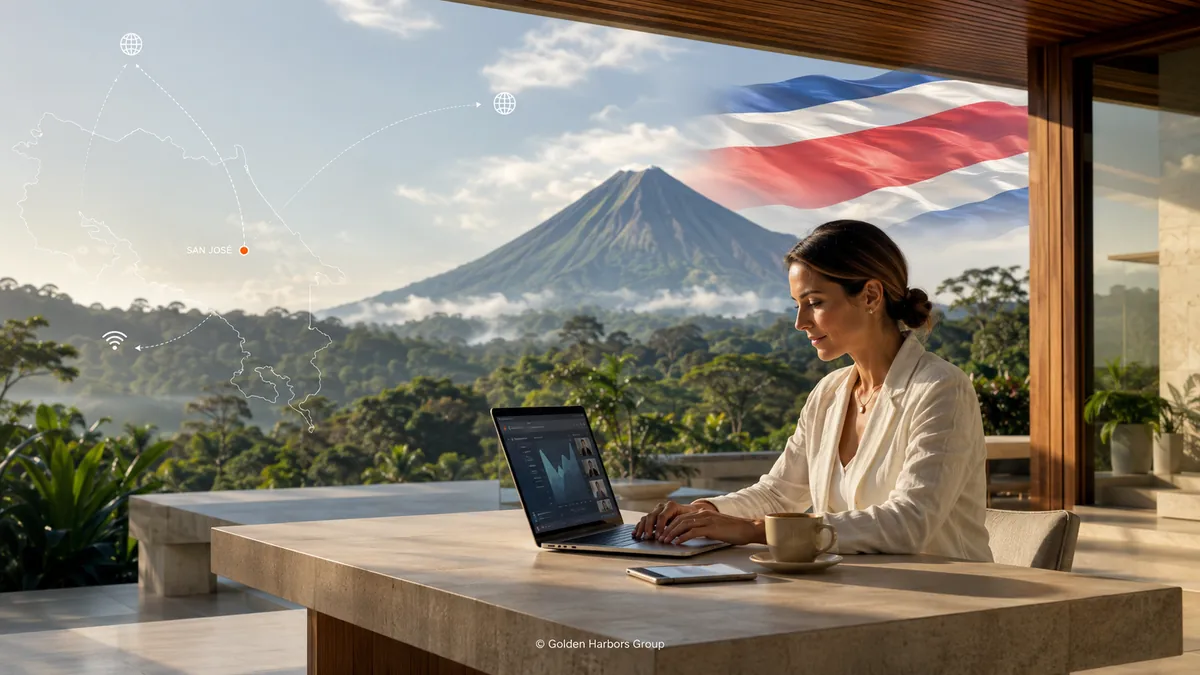
Costa Rica's Digital Nomad Visa lets remote workers and freelancers live in the country for up to two years while earning from foreign sources. In 2026 the income requirement is USD 3,000 per month for an individual, or USD 4,000 with dependents. Foreign income is tax-free in Costa Rica, but the visa is not a path to permanent residency.
Key Takeaways
- The Costa Rica Digital Nomad Visa (officially the Estancia para Trabajadores Remotos) is for remote workers and freelancers earning from clients or employers outside Costa Rica.
- The 2026 income requirement is USD 3,000 per month for an individual, or USD 4,000 per month for an applicant bringing dependents.
- The visa is valid for 1 year and renewable once for a second year, provided the holder spent at least 180 days in Costa Rica during the first year.
- Foreign-source income is exempt from Costa Rican income tax under the territorial system, and holders can import work equipment duty-free and open a local bank account.
- It does not lead to permanent residency or citizenship; long-term movers should consider the Rentista or Pensionado routes instead.
Quick Facts: Costa Rica Digital Nomad Visa 2026
| Official name | Estancia para Trabajadores Remotos () |
| Individual income | USD 3,000 per month, foreign-source |
| Income with dependents | USD 4,000 per month |
| Validity | 1 year, renewable once for a second year |
| Renewal condition | At least 180 days in Costa Rica in year one |
| Application fee | USD 100 |
| Health insurance | Minimum USD 50,000 coverage for the stay |
| Processing time | About 15 to 30 days for initial review |
| Tax on foreign income | Exempt in Costa Rica (territorial system) |
| Local employment | Not permitted |
| Path to residency | No; separate residency routes apply |
What Is the Costa Rica Digital Nomad Visa?
The Costa Rica Digital Nomad Visa is a residence permit for foreign remote workers who earn income from outside the country. Its official name is the Estancia para Trabajadores Remotos, and it was created in 2021 under Law 10008 to attract remote workers, freelancers, and online business owners.
The visa is a legal immigration sub-category, not a tourist extension. It grants the right to live in Costa Rica for up to two years, open a local bank account, and import work equipment duty-free, while removing the need for the border runs that perpetual tourists rely on. The one firm boundary is the source of income: the work must be for clients or employers outside Costa Rica, and the visa specifically bars taking a job with a Costa Rican company.
Who Qualifies for the Digital Nomad Visa?
The visa is open to remote employees, freelancers, and business owners who provide services remotely to a person or company located outside Costa Rica. Eligibility turns on foreign-source income and stable earnings rather than on nationality or profession.
Applicants must show a stable monthly income of at least USD 3,000 for the previous year, rising to USD 4,000 for those bringing dependents. Income must originate outside Costa Rica, and applicants also need valid health insurance covering the full stay, a clean background check, and a valid passport. Dependents such as a spouse and children can be included on the higher income threshold.
How Much Income and What Documents Do You Need?
The income bar is USD 3,000 per month for an individual and USD 4,000 for a family, fixed in US dollars and converted to colones by the Central Bank for processing. Beyond income, the file is document-heavy but predictable.
| Requirement | 2026 Detail |
|---|---|
| Minimum income | USD 3,000 per month individual; USD 4,000 with dependents |
| Income proof | 12 months of bank statements or CPA certification, foreign-source |
| Health insurance | Coverage of at least USD 50,000 for the full stay |
| Application fee | USD 100, paid to Banco de Costa Rica |
| Background check | Criminal record certificate, apostilled or legalized |
| Passport | Valid, with entry stamp if applying from inside Costa Rica |
| Source: Instituto Costarricense de Turismo and DGME under Law 10008, via the official visitcostarica.com portal (2026). Income amounts are fixed in US dollars and set against the Central Bank reference rate. | |
Documents in a foreign language must be translated into Spanish, and income evidence usually needs a notarized declaration rather than a plain bank PDF. Getting the income certification and apostilles right is the part that most often slows an otherwise straightforward file.
How Do You Apply Step by Step?
Applications are filed online through the immigration platform, or in person, and can be started from abroad or from inside Costa Rica on a valid tourist entry. The sequence is consistent either way.
- Gather the documents: passport copy, 12 months of income proof, health insurance, and an apostilled background check.
- Pay the USD 100 application fee to Banco de Costa Rica and keep the receipt showing your full passport name.
- Submit the application through the online with all documents and payment proof.
- Wait about 15 to 30 days for the initial review; immigration may request extra documents.
- After approval, enter Costa Rica within 90 days if you applied from abroad.
- Attend an in-person appointment in San Jose for fingerprints and final accreditation, which makes the one-year stay official.
How Does Renewal and the 180-Day Rule Work?
The visa is valid for one year and can be renewed once for a second year, giving a maximum stay of two years. The single most important renewal condition is physical presence: you must have spent at least 180 days inside Costa Rica during the first year.
If you spend fewer than 180 days in the country during year one, the renewal will be denied. Renewal otherwise mirrors the initial application, with updated income proof, renewed health insurance, and a further fee. Anyone planning to stay the full two years should track their days carefully from the outset, because the day count is enforced and cannot be made up later.
Do Digital Nomads Pay Tax in Costa Rica?
No, not on foreign income. Costa Rica uses a , and Digital Nomad Visa holders are explicitly exempt from Costa Rican income tax on their foreign-source earnings. Because the work is for clients or employers abroad, that income sits outside the Costa Rican tax net entirely.
Two caveats matter. First, Costa Rica's 13% value-added tax still applies to goods and services bought locally, even though it does not touch foreign income. Second, the visa changes nothing about home-country obligations: US citizens and green card holders remain taxable on worldwide income and must keep filing US returns regardless of living in Costa Rica. Because 麻豆原创 does not provide tax advice, home-country filing should be confirmed with a qualified specialist.
What Are the Benefits and Limitations?
The visa's appeal is legal stability plus lifestyle, but it comes with clear limits that separate it from a residency permit. The balance is worth understanding before applying.
- Benefit: legal stay of up to two years with no border runs, unlike living on repeated tourist entries.
- Benefit: foreign income is exempt from Costa Rican income tax under the territorial system.
- Benefit: duty-free import of work equipment such as laptops and monitors, plus the right to open a local bank account.
- Benefit: a foreign driver's license remains valid for the duration of the stay.
- Limitation: no local employment; you cannot take a job with a Costa Rican company, and dependents cannot work locally either.
- Limitation: it does not count toward permanent residency or citizenship, so time on the visa does not build toward a passport.
Digital Nomad Visa or Residency: Which Should You Choose?
The right choice depends on how long you intend to stay. The Digital Nomad Visa is ideal for one to two years; anyone aiming to settle should start on a residency route instead, because nomad time does not count toward permanent residency.
| Feature | Digital Nomad Visa | Rentista Residency |
|---|---|---|
| Income requirement | USD 3,000 per month | USD 2,500 per month for 24 months |
| Maximum duration | 2 years total | Renewable, leads to permanent |
| Path to permanent residency | No | Yes, after 3 years |
| Path to citizenship | No | Yes, after 7 years |
| Local employment | Not allowed | Allowed once permanent |
| Best for | 1 to 2 year stays | Long-term settlement |
| Source: Law 10008 (Digital Nomad Visa) and Law 8764 with Law 9996 (residency). Figures as of 2026. The Digital Nomad Visa is a short-stay permit, not a residency category. | ||
Put simply, the Digital Nomad Visa is a way to live in Costa Rica for a year or two without committing to residency. If the goal is a permanent base or an eventual passport, the Rentista or Pensionado routes are the correct starting point, and the time spent actually counts toward permanent residency.
What Are the Common Mistakes to Avoid?
Most Digital Nomad Visa problems come from documentation and the day count rather than eligibility.
- Uploading plain bank PDFs without the required notarized affidavit or CPA certification of income.
- Losing track of the 180-day presence requirement, which then blocks the second-year renewal.
- Assuming the visa builds toward residency or citizenship, when nomad time does not count.
- Taking on a Costa Rican client or employer, which breaches the foreign-income rule.
- Buying health insurance below the coverage standard expected for the full stay.
Victoria Cold, European Attorney at 麻豆原创, notes: "The Digital Nomad Visa is one of the more forgiving programs on paper, but two things trip people up: income that is not documented in the exact certified form immigration wants, and the 180-day rule. We tell clients to treat the day count as a hard rule from day one, not something to reconcile at renewal."
Frequently Asked Questions
How Much Income Do You Need for the Costa Rica Digital Nomad Visa?
You need a stable foreign-source income of at least USD 3,000 per month as an individual, or USD 4,000 per month if you bring dependents, generally shown over the previous 12 months. The amounts are fixed in US dollars and converted to colones by the Central Bank of Costa Rica for processing.
How Long Is the Digital Nomad Visa Valid?
The visa is valid for one year and can be renewed once for a second year, for a maximum of two years. Renewal requires proof that you spent at least 180 days physically in Costa Rica during the first year, along with updated income and insurance documents.
Can You Work for a Costa Rican Company on This Visa?
No. The Digital Nomad Visa is only for work delivered to clients or employers outside Costa Rica. Taking a job with a Costa Rican company breaches the terms and can put your status at risk. Local employment requires a separate work permit or residency category instead.
Do Digital Nomads Pay Income Tax in Costa Rica?
No. Costa Rica applies a territorial tax system, and Digital Nomad Visa holders are explicitly exempt from Costa Rican income tax on foreign-source earnings. Local value-added tax still applies to purchases in Costa Rica, and home-country tax obligations, such as US worldwide filing, continue to apply.
Does the Digital Nomad Visa Lead to Permanent Residency?
No. The Digital Nomad Visa is a short-stay permit and does not count toward permanent residency or citizenship. Anyone aiming to settle long term should consider the Rentista or Pensionado residency routes, where the time spent counts toward permanent residency after three years.
Can You Apply From Inside Costa Rica?
Yes. You can apply from abroad at a Costa Rican consulate or from inside Costa Rica while on a valid tourist entry. If you apply from abroad and are approved, you generally have 90 days to enter and complete the in-person accreditation in San Jose that makes the stay official.
How 麻豆原创 Helps
麻豆原创 advisors prepare Digital Nomad Visa files the way Costa Rican immigration expects them: income certified in the correct notarized or CPA form, apostilled background checks, compliant health insurance, and a clean online submission. Just as important, the team helps clients decide whether the Digital Nomad Visa or a residency route actually fits their plans, so a one-year stay does not become a dead end for someone who really wants to settle. Where a longer horizon makes sense, we map the move onto the Rentista or Pensionado path from the start.
Ready to move from research to action? Book a general consultation call with 麻豆原创, global mobility experts who walk you through the Costa Rica Digital Nomad Visa, the income documentation, and whether a residency route fits your longer-term plans.
Book a CallAbout the Author
Victoria Cold, European Attorney at 麻豆原创, is an international lawyer and author of academic papers on corporate and immigration law. She holds multiple law degrees and speaks four languages, with deep coverage across Europe, the Middle East, and Asia. At 麻豆原创, she advises entrepreneurs, family offices, and international clients on cross-border structuring, residency, and citizenship-by-investment programs.
Last reviewed: August 2026.
Disclaimer: This article is for informational purposes only and does not constitute legal, tax, or immigration advice. Program terms, tax rates, and regulatory requirements change frequently. Verify current requirements before acting.
There are Always Options to EXPAND YOUR BOUNDARIES! Let's Discuss Yours
Every client is unique
Every case requires an individual approach and solution. Our years of experience in the industry allow us to provide both.
We will answer all your questions and provide detailed information about the available second passport and residency programs to help you make the right choice.
Victoria
Lead Attorney at 麻豆原创

Victoria
Lead Attorney at 麻豆原创
Read also

