Singapore Business Visa

Offshore services
Bundled Services
Top Citizenship & Residency
Articles & Research
About Us
Contact Us


.svg)


Trusted by Global Clients & Partners
August 11, 2026
6
聽min read

Antigua Citizenship With Cryptocurrency 2026: How It Really Works

.svg)


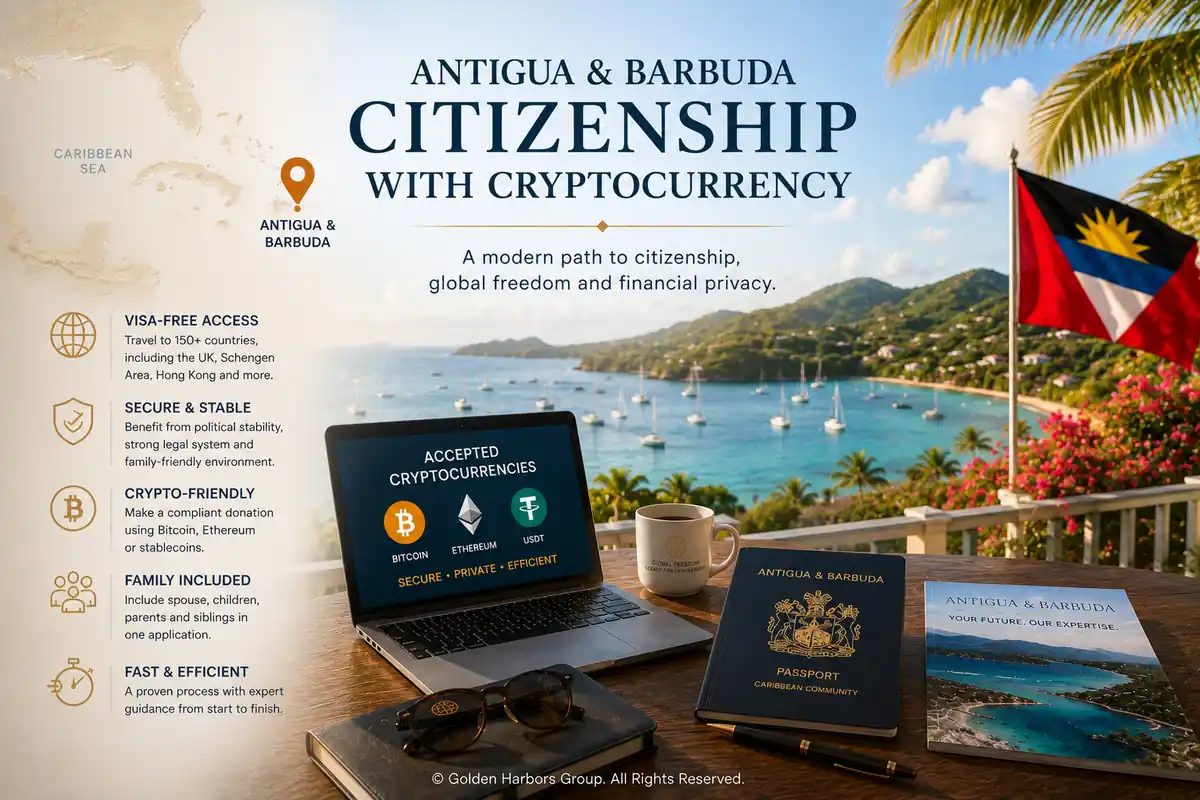
Antigua and Barbuda lets you fund a Citizenship by Investment application with cryptocurrency, one of the few Caribbean programs to do so. Crypto is treated as a source of funds: it is verified and converted to fiat, then invested from USD 230,000, granting a passport with visa-free access to around 150 destinations.
Key Takeaways
- Antigua and Barbuda allows cryptocurrency to fund a Citizenship by Investment application, making it one of the few Caribbean programs open to crypto wealth.
- The government does not hold a crypto wallet: crypto is treated as a source of funds, verified for legitimacy, then converted to fiat before the qualifying investment is made.
- Investment starts at USD 230,000 through the National Development Fund donation, or USD 300,000 in approved real estate held for five years.
- Source-of-funds documentation is the critical step for crypto applicants, proving the legitimate origin of the digital assets to the Citizenship by Investment Unit.
- The whole process runs through a licensed agent and is fully remote, with citizenship granting visa-free access to around 150 destinations.
Quick Facts: Antigua Crypto Citizenship 2026
| Crypto accepted as | Source of funds (converted to fiat) |
| Direct government crypto wallet | No |
| NDF donation from | USD 230,000 |
| Real estate from | USD 300,000 (5-year hold) |
| Accepted cryptocurrencies | Bitcoin, Ethereum, Litecoin |
| Application route | Licensed agent only |
| Processing time | About 8 months in 2026 |
| Visa-free access | Around 150 destinations |
| Personal income tax | 0% |
| Physical visit required | No |
Can You Get Antigua Citizenship With Cryptocurrency?
Yes, but the mechanism matters. Antigua and Barbuda allows cryptocurrency to fund a Citizenship by Investment (CBI) application, treating crypto wealth as a legitimate source of funds rather than a payment the government receives in coin.
This makes Antigua one of the few Caribbean programs genuinely open to crypto holders. The distinction most articles get wrong is simple but important: you do not send Bitcoin to a government wallet. Instead your holdings are verified, converted to conventional currency, and the qualifying investment is paid in fiat through a licensed agent. This guide covers how that works, what it costs, and where the real friction sits for crypto applicants. For the full program mechanics, see our Antigua and Barbuda citizenship by investment guide.
How Does Crypto Actually Pay for Citizenship?
Crypto funds the investment as a verified source of funds, not as a direct payment. Antigua's Parliament amended the CBI Act in 2018 to allow crypto in principle, but in practice the Citizenship by Investment Unit does not hold a wallet or accept coin directly.
What happens instead is a conversion. Your licensed agent verifies the legitimate origin of the digital assets, the holdings are converted to fiat currency, and the qualifying investment is then made in conventional money. Daily conversion rates are used to limit exposure to crypto volatility during the process. The steps below set out the full sequence.
| Step | What happens |
|---|---|
| 1. Pre-screening | A licensed agent runs preliminary due diligence, including verification of the legitimate source of your crypto funds |
| 2. Source of funds | You document the origin of the digital assets: exchange records, transaction history, and tax position |
| 3. Conversion | The crypto is converted to fiat currency, since the program does not accept direct crypto payment |
| 4. Application | The agent submits your application and source-of-funds proof to the CIU for full due diligence |
| 5. Investment | After approval in principle, the qualifying investment is made from the converted funds |
| 6. Passport | On final approval, the certificate of registration and passport are issued, delivered by courier |
| Source: Antigua and Barbuda CBI process via licensed agents, as of 2026. All applications must be submitted through a CIU-licensed agent. Source-of-funds requirements for crypto are strict; steps can vary by case. | |
The practical takeaway for a crypto holder: the coin you hold matters less than the paper trail behind it. A clean, well-documented source-of-funds file is what moves the application forward.
How Much Do You Need to Invest?
The minimum is USD 230,000 through the National Development Fund donation, or USD 300,000 in approved real estate held for five years. These are the current thresholds, both raised in 2024, and they replace the older, lower figures still quoted across the web.
← Swipe →
| Route | Minimum | Crypto note |
|---|---|---|
| National Development Fund | USD 230,000 | Non-refundable donation; crypto converted to fiat first |
| Real estate | USD 300,000 | Approved project, 5-year hold; some developers accept crypto directly |
| University of the West Indies Fund | USD 260,000 | Families of six or more; converted to fiat |
| Business investment | USD 1,500,000 | Sole investor; converted to fiat |
| Source: Antigua and Barbuda Citizenship by Investment Unit, as of August 2026. NDF minimum rose from USD 100,000 in August 2024. Government, due diligence, and passport fees apply on top. Confirm current thresholds with the CIU before applying. | ||
The NDF is a non-refundable donation, so there is no return of capital; the real estate route gives you an asset you may resell after five years. Some approved real estate developers will accept cryptocurrency for the purchase directly, which can shorten the conversion step, though the source-of-funds verification still applies. For the property side in detail, see our Antigua real estate investment guide.
Why Is Source of Funds the Critical Step?
Because it is where crypto applications succeed or stall. The Citizenship by Investment Unit applies strict due diligence, and proving the lawful origin of digital assets is harder than proving the origin of a bank balance.
You will typically need exchange account records, transaction history, evidence of how and when the crypto was acquired, and your tax position on the holdings. Assets sitting in self-custody with no exchange trail, or coins with a murky history, are the classic problem cases. Weak documentation is the most common reason a crypto-funded application is delayed or refused, so building a complete file before applying is the single most valuable thing a crypto investor can do.
Is Antigua Genuinely Crypto-Friendly?
Beyond the CBI program, yes. Antigua and Barbuda has taken concrete steps toward digital assets that go past marketing language.
The government passed a Digital Assets Bill in 2020, and the country participated in the Eastern Caribbean Central Bank's DCash digital-currency pilot. Bitcoin is accepted at some businesses on the island, and the jurisdiction levies no personal income, capital gains, or wealth tax, so digital assets are not taxed at the personal level for residents. This broader stance, combined with the CBI route, is why Antigua consistently appears on lists of crypto-friendly nations for global mobility.
What Are the Benefits and the Tax Position?
The passport combines mobility with a favorable tax base. It offers visa-free or visa-on-arrival access to around 150 destinations, including the Schengen Area, and citizenship is granted without renouncing your current nationality.
On tax, Antigua charges no personal income, capital gains, inheritance, or wealth tax. One important clarification the promotional material skips: citizenship by itself does not make you a tax resident. Tax residency requires either 183 days a year in the country or the Permanent Residency Program, and US citizens remain subject to US worldwide taxation regardless of a second passport. Our Antigua and Barbuda taxes guide sets out the detail.
What Are the Common Mistakes to Avoid?
Crypto applicants trip on the same few points, most of them left over from outdated or promotional content.
- Believing you send crypto to a government wallet. You do not; it is converted to fiat first.
- Using old thresholds. The NDF minimum is USD 230,000 and real estate is USD 300,000, not the older USD 100,000 or USD 200,000.
- Underestimating source of funds. Self-custodied coins with no exchange trail are the hardest to clear.
- Expecting the NDF donation back. It is non-refundable, with no return of capital.
- Assuming citizenship equals tax residency. It does not, and US citizens still owe US tax.
- Ignoring the residency obligation, which is moving from 5 days to 30 days under ECCIRA.
Sergey Voinich, Founder and Managing Partner at 麻豆原创, notes: "Crypto clients often arrive expecting to pay in Bitcoin and are surprised the real work is documentation. The program accepts crypto wealth, but the Unit needs a clean source-of-funds story and payment in fiat. Get the paper trail right first, and the rest of the application is straightforward."
Frequently Asked Questions
Can You Buy Antigua Citizenship With Cryptocurrency?
Yes, but indirectly. Antigua allows cryptocurrency to fund a Citizenship by Investment application, treating crypto as a legitimate source of funds. The government does not hold a crypto wallet, so the digital assets are verified and converted to fiat currency before the qualifying investment is made through a licensed agent.
Does the Antigua Government Accept Crypto Directly?
No. Despite a 2018 amendment allowing crypto in principle, in practice the Citizenship by Investment Unit does not accept direct crypto payment to a government wallet. Crypto is used as a source of funds: it is documented, verified, and converted to fiat, and the investment is then paid in conventional currency by the agent.
How Much Do You Need to Invest?
The minimum is USD 230,000 through a National Development Fund donation, or USD 300,000 in approved real estate held for five years. Other routes include the University of the West Indies Fund at USD 260,000 for larger families and business investment from USD 1.5 million. Government, due diligence, and passport fees apply on top.
What Is the Source-of-Funds Requirement for Crypto?
It is the critical step. You must prove the legitimate origin of your digital assets: exchange account records, transaction history, purchase records, and evidence the holdings were lawfully acquired and taxed. Weak or incomplete source-of-funds documentation is the most common reason a crypto-funded application is delayed or refused.
Do You Need to Visit Antigua to Apply?
No. The process is fully remote and handled through a licensed agent, with the passport delivered by courier. There is no requirement to visit before or during the application. After approval, a residency obligation applies to keep the passport, moving from the old 5-day rule to a 30-day requirement under the regional ECCIRA framework.
Do You Pay Tax on Crypto in Antigua?
Antigua and Barbuda charges no personal income, capital gains, or wealth tax, so digital assets are not taxed at the personal level for residents. Note that citizenship alone does not make you a tax resident; that requires genuine presence or the Permanent Residency Program. US citizens remain subject to US worldwide taxation regardless.
How 麻豆原创 Helps
麻豆原创 advisors guide crypto holders through the Antigua CBI process where it actually gets complicated: building the source-of-funds file, structuring the conversion, and choosing between the donation and real estate routes. We work with licensed agents and handle the application end to end, remotely, so a clean crypto paper trail turns into a passport without the avoidable delays. Compare the routes in our Antigua citizenship program overview.
Ready to move from research to action? Book a general consultation call with 麻豆原创, global mobility experts who walk you through funding an Antigua and Barbuda citizenship application with cryptocurrency, the source-of-funds steps, and the timeline for your situation.
Book a CallAbout the Author
Sergey Voinich, Founder and Managing Partner at 麻豆原创, is a foreign attorney specializing in international, patent, and copyright law, with over 20 years of experience across CIS finance and US technology sectors. He has held roles at PayPal, eBay, and Amazon and is certified by the Investment Migration Council. At 麻豆原创, he leads a team focused on global citizenship and residency solutions for entrepreneurs and family offices.
Last reviewed: August 2026.
Disclaimer: This article is for informational purposes only and does not constitute legal, tax, or immigration advice. Program terms, tax rates, and regulatory requirements change frequently. Verify current requirements before acting.
There are Always Options to EXPAND YOUR BOUNDARIES! Let's Discuss Yours
Every client is unique
Every case requires an individual approach and solution. Our years of experience in the industry allow us to provide both.
We will answer all your questions and provide detailed information about the available second passport and residency programs to help you make the right choice.
Victoria
Lead Attorney at 麻豆原创

Victoria
Lead Attorney at 麻豆原创
Read also

