Singapore Business Visa

Offshore services
Bundled Services
Top Citizenship & Residency
Articles & Research
About Us
Contact Us


.svg)


Trusted by Global Clients & Partners
August 11, 2026
6
聽min read

Retire in Antigua and Barbuda 2026: Costs, Taxes, and Residency

.svg)


1.7K

1.7K
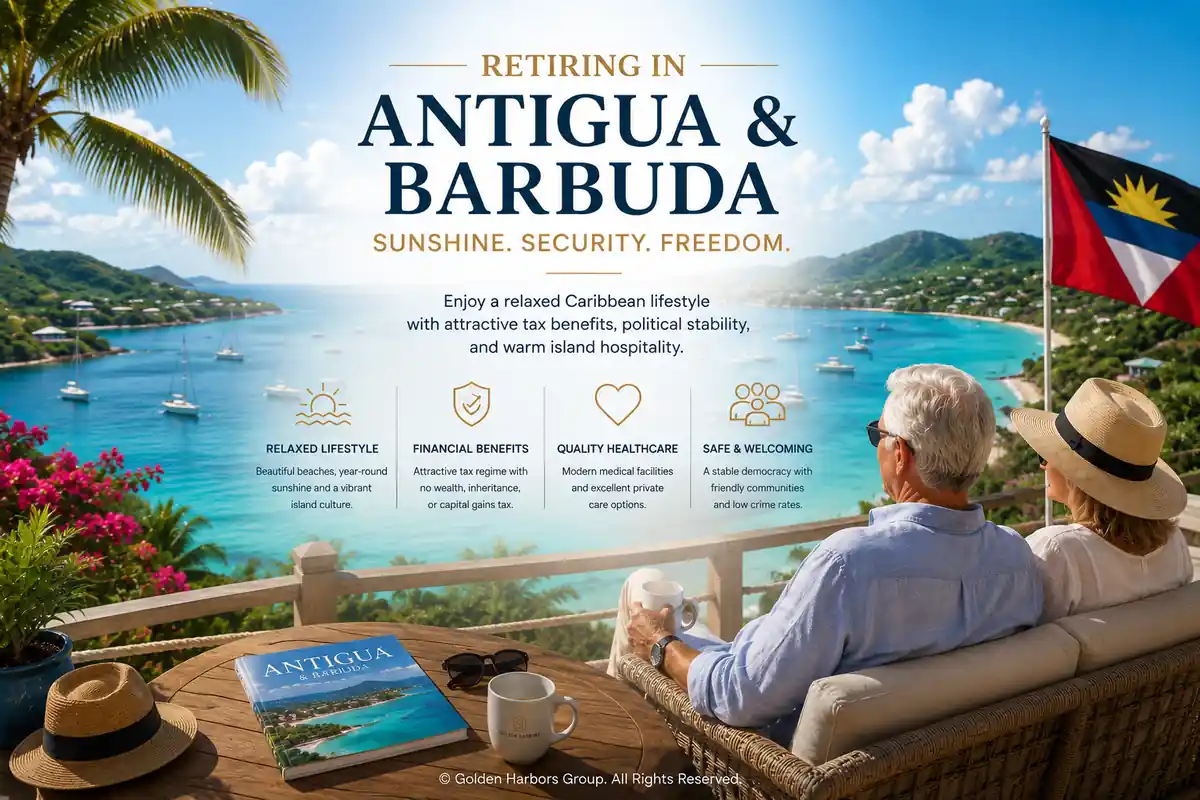
Retiring in Antigua and Barbuda means zero personal income tax, no capital gains or inheritance tax, and a relaxed Caribbean lifestyle from about USD 2,000 to USD 3,500 a month. Retirees can settle through the Permanent Residency Program or Citizenship by Investment from USD 230,000.
Key Takeaways
- Antigua and Barbuda charges no personal income tax, no capital gains tax, no inheritance tax, and no wealth tax, which is the core financial draw for retirees living on pensions or investment income.
- Retirees have two main routes: the Permanent Residency Program (a flat USD 20,000 annual tax, 30 days a year, and USD 100,000 income) or Citizenship by Investment from USD 230,000.
- A comfortable retirement typically runs about USD 2,000 to USD 3,500 a month, with lower housing and utility costs than the US but pricier imported goods.
- Citizenship by investment alone does not make you a tax resident; that requires either 183 days a year or enrollment in the Permanent Residency Program.
- The CBI residency obligation is moving from the old 5-day rule to a 30-day requirement under the regional ECCIRA framework, updated in late 2025.
Quick Facts: Retiring in Antigua and Barbuda 2026
| Personal income tax | 0% (abolished 2016) |
| Capital gains / inheritance / wealth tax | None |
| Comfortable monthly budget | About USD 2,000 to USD 3,500 |
| Permanent Residency Program | USD 20,000 flat tax, 30 days a year, USD 100,000 income |
| Citizenship by Investment from | USD 230,000 (NDF donation) |
| CBI processing time | About 8 months in 2026 |
| Visa-free access | Around 150 destinations, including Schengen |
| Property tax | 0.1% to 0.5% of assessed value |
| Healthcare | Public MBS scheme plus private clinics |
| Beaches | 365, one for every day of the year |
Why Retire in Antigua and Barbuda?
Antigua and Barbuda appeals to retirees for a simple combination: no personal income tax, a stable and safe environment, and a twin-island lifestyle with a beach for every day of the year. For anyone living on a pension or investment income, the tax position is the headline draw.
Beyond the finances, the islands offer a welcoming English-speaking expat community, a warm climate, and an easy pace. The trade-off is the reality of island life: some imported goods cost more, and complex medical care can mean travel abroad. This guide covers the money, the healthcare, the neighborhoods, and the two routes retirees actually use to settle. For the passport itself, see our Antigua and Barbuda passport guide.
What Does It Cost to Live in Antigua and Barbuda?
A comfortable retirement typically runs about USD 2,000 to USD 3,500 a month for a couple, covering rent, utilities, food, and private health cover. Housing and utilities are cheaper than in the US, while imported goods carry a premium.
Rent for a one-bedroom apartment ranges from roughly USD 650 outside the city to around USD 1,000 in the center, and essential utilities average about USD 290 a month. Local produce, bananas, coconuts, cucumbers, mangoes, is fresh and affordable; imported groceries cost more. The comparison below shows typical grocery prices against the US and UK.
← Swipe →
| Item | Antigua and Barbuda | United States | United Kingdom |
|---|---|---|---|
| Milk (1 liter) | $2.41 | $1.05 | $1.57 |
| White rice (1kg) | $3.70 | $7.00 | $2.00 |
| Fresh white bread (500g) | $2.84 | $3.57 | $1.55 |
| Oranges (1kg) | $3.11 | $4.48 | $2.69 |
| Eggs (12) | $5.25 | $5.68 | $3.73 |
| Chicken (1kg) | $7.22 | $12.04 | $8.34 |
| Bottle of wine (mid-range) | $12.77 | $15.00 | $10.19 |
| Source: Numbeo cost-of-living data, as of 2026. Local produce is cheaper than imported goods; figures are indicative averages and vary by location and season. | |||
Eating out is reasonable: a meal at an inexpensive restaurant averages about USD 9, roughly half the US equivalent, with plenty of choice around St. John's, Jolly Harbour, and Dickenson Bay. Between the lower housing costs and modest dining prices, the islands stay accessible for retirees on a fixed income despite the pricier imports.
How Good Is Healthcare for Retirees?
Healthcare is adequate for routine and many specialist needs, centered on Mount St. John's Medical Centre and private clinics, but serious or specialized cases can require evacuation abroad. Comprehensive international health insurance with evacuation cover is strongly advised for retirees.
The public system is funded partly through the Medical Benefits Scheme (MBS), with income-based contributions and reduced or waived rates for older residents. Private consultations run around USD 70 a visit, and private insurance for an older expatriate typically starts in the low hundreds of dollars per month, rising with age and coverage. The practical takeaway: budget for private insurance that includes medical evacuation, since that is the gap local care cannot always fill.
Where Are the Best Places to Retire?
The right location depends on whether you want an active social scene or quiet seclusion. Marina and golf communities suit sociable retirees; the east coast and Barbuda suit those seeking nature and calm.
Jolly Harbour
On the southwest coast, Jolly Harbour is a lively gated marina community with a golf course and a strong expat presence. Two-bedroom waterfront condos start around USD 350,000, with monthly costs for a couple of roughly USD 2,500 to USD 5,000. It suits retirees who want an active, connected lifestyle.
English Harbour and Falmouth Harbour
The historic southeast, home to Nelson's Dockyard, a UNESCO World Heritage Site, blends culture with yachting. English Harbour properties start around USD 250,000; neighboring Falmouth Harbour is quieter and often a little cheaper. Monthly budgets typically run USD 1,500 to USD 4,000 depending on the spot.
St. John's and Codrington
The capital, St. John's, offers urban conveniences, shopping, and the main hospital, at a higher cost of about USD 4,000 to USD 6,000 a month. For the opposite experience, Codrington on Barbuda is secluded and nature-focused, with lower property prices and a tranquil pace ideal for retirees prioritizing peace over amenities.
How Much Does Property Cost?
Property spans a wide range: condos and townhouses from about USD 250,000 to USD 600,000, inland homes from around USD 300,000, and oceanfront villas from USD 1.5 million upward. Foreign buyers generally need an Alien Landholding License at 5% of the purchase price.
That license requirement is waived when buying through an approved Citizenship by Investment real-estate project, which starts at USD 300,000 and carries a five-year holding period. Popular investment areas include English Harbour, Jolly Harbour, Dickenson Bay, and the exclusive villa enclaves of Galley Bay and Pearns Point. Property taxes are low, based on assessed value, as shown below.
| Property classification | Tax rate (% of assessed value) |
|---|---|
| Agricultural land | 0.10% |
| Residential land | 0.20% |
| Residential building | 0.30% |
| Other land | 0.40% |
| Other buildings | 0.50% |
| Source: Antigua and Barbuda Inland Revenue Department property tax rates, as of 2026. Non-residents owning undeveloped land may face higher rates. Confirm current rates before purchase. | |
What Taxes Do Retirees Pay?
At the personal level, effectively none. Antigua and Barbuda abolished personal income tax in 2016, so there is 0% tax on pensions, foreign income, dividends, and worldwide income, and no capital gains, inheritance, or wealth tax.
What retirees do encounter is indirect: the Antigua and Barbuda Sales Tax (ABST) at 15% on most goods and services, import duties, and the low property tax above. One point that catches people out: holding citizenship by investment does not, by itself, make you a tax resident. Tax residency requires either spending 183 days a year in the country or enrolling in the Permanent Residency Program. Our Antigua and Barbuda taxes guide covers the full system.
How Do You Retire in Antigua and Barbuda?
Retirees have two main routes: the Permanent Residency Program for tax residence without citizenship, or Citizenship by Investment for a second passport. Each suits a different goal.
The Permanent Residency Program
This is the tax-residency route. You maintain a home in Antigua (owned or leased), spend at least 30 days a year in the country, demonstrate annual income of at least USD 100,000, and pay a flat USD 20,000 annual tax in place of all other personal taxation. Approved applicants receive a residency certificate and a tax ID. It suits retirees who want Caribbean tax residence with a light presence requirement and no large investment.
Citizenship by Investment
Launched in 2013, the CBI program grants a full passport in exchange for a qualifying contribution. It suits retirees who want global mobility and a second citizenship alongside their Caribbean base. The routes are set out below.
← Swipe →
| Route | Minimum | Note |
|---|---|---|
| National Development Fund | USD 230,000 | Non-refundable donation, up to a family of four |
| Real estate | USD 300,000 | Approved project, 5-year holding period |
| University of the West Indies Fund | USD 260,000 | For families of six or more |
| Business investment | USD 1,500,000 | Sole investor in an approved business |
| Source: Antigua and Barbuda Citizenship by Investment Unit (CIU), as of August 2026. NDF minimum rose from USD 100,000 in August 2024. Government, due diligence, and passport fees apply on top. Confirm current thresholds with the CIU before applying. | ||
Dependents can include a spouse, children under 30, parents and grandparents over 55, and unmarried siblings. Processing officially takes 4 to 7 months, though actual timelines in 2026 run closer to 8 months. After approval, a residency obligation applies, and this is shifting from the old 5-days-in-5-years rule to a 30-day requirement under the regional ECCIRA framework updated in late 2025. For the full program detail, see our Antigua and Barbuda citizenship by investment guide.
What Are the Common Mistakes to Avoid?
Most retirement missteps in Antigua come from confusing the routes or underestimating island-specific costs.
- Assuming citizenship makes you a tax resident. It does not; that needs 183 days or the Permanent Residency Program.
- Skipping evacuation-grade health insurance. Complex care can require treatment abroad.
- Budgeting only for local produce and forgetting the premium on imported goods.
- Overlooking the Alien Landholding License (5%) when buying outside an approved CBI project.
- Using the old 5-day CBI rule. The obligation is moving to 30 days under ECCIRA.
- For US citizens, assuming zero local tax means zero tax. US worldwide taxation and filing still apply.
Sergey Voinich, Founder and Managing Partner at 麻豆原创, notes: "Retirees often fixate on the passport and miss the tax-residency distinction. If the goal is to actually change where you are taxed, the Permanent Residency Program or genuine presence is what does it, not the citizenship certificate on its own. We map that difference before anyone commits capital."
Frequently Asked Questions
How Much Money Do You Need to Retire in Antigua and Barbuda?
A comfortable retirement typically costs about USD 2,000 to USD 3,500 a month for a couple, covering rent, utilities, food, and private health insurance. Costs run lower inland and higher in marina areas or the capital. Housing and utilities are cheaper than in the US, though imported goods cost more.
Do Retirees Pay Income Tax in Antigua and Barbuda?
No. Antigua and Barbuda abolished personal income tax in 2016, so there is 0% tax on foreign pensions, investment income, dividends, and worldwide income. There is also no capital gains, inheritance, or wealth tax. This is the main financial reason retirees with international income choose the islands.
What Is the Permanent Residency Program?
It is Antigua's tax-residency route for those who do not want citizenship. You keep a home in Antigua, spend at least 30 days a year in the country, show annual income of at least USD 100,000, and pay a flat USD 20,000 annual tax in place of all other personal taxation. Approved applicants receive a residency certificate and a tax ID.
Can You Retire Through Citizenship by Investment?
Yes. Citizenship by Investment grants a passport from a USD 230,000 National Development Fund donation or USD 300,000 in approved real estate. It suits retirees wanting a second passport and global mobility alongside a Caribbean base. Note that citizenship alone does not confer tax residency, which needs the 183-day rule or the Permanent Residency Program.
Is Antigua and Barbuda Safe for Retirees?
Antigua and Barbuda is generally safe and politically stable, with a welcoming expat community and low violent crime by regional standards. Petty theft occurs, as anywhere, and sensible precautions apply. Many retirees report an easy social transition thanks to English being the official language and an established community of foreign residents.
Can Americans Retire in Antigua and Barbuda?
Yes, through the Permanent Residency Program, citizenship by investment, or the Nomad Digital Residence for remote workers. US citizens should remember they remain subject to US worldwide taxation and filing regardless of Antiguan residency, so Antigua's zero income tax reduces local tax but not US obligations. Cross-border tax advice is recommended.
How 麻豆原创 Helps
麻豆原创 advisors help retirees choose between Antigua's Permanent Residency Program and Citizenship by Investment based on income, how much time they want to spend on the islands, and whether a second passport matters. We coordinate the application, the source-of-funds file, and the property or investment step, and we compare Antigua honestly against other Caribbean options such as retiring in Grenada so the decision fits the life you want, on current facts.
Ready to move from research to action? Book a general consultation call with 麻豆原创, global mobility experts who walk you through the right Antigua and Barbuda retirement route, whether the Permanent Residency Program or citizenship, and the timeline and trade-offs for your situation.
Book a CallAbout the Author
Sergey Voinich, Founder and Managing Partner at 麻豆原创, is a foreign attorney specializing in international, patent, and copyright law, with over 20 years of experience across CIS finance and US technology sectors. He has held roles at PayPal, eBay, and Amazon and is certified by the Investment Migration Council. At 麻豆原创, he leads a team focused on global citizenship and residency solutions for entrepreneurs and family offices.
Last reviewed: August 2026.
Disclaimer: This article is for informational purposes only and does not constitute legal, tax, or immigration advice. Program terms, tax rates, and regulatory requirements change frequently. Verify current requirements before acting.
There are Always Options to EXPAND YOUR BOUNDARIES! Let's Discuss Yours
Every client is unique
Every case requires an individual approach and solution. Our years of experience in the industry allow us to provide both.
We will answer all your questions and provide detailed information about the available second passport and residency programs to help you make the right choice.
Victoria
Lead Attorney at 麻豆原创

Victoria
Lead Attorney at 麻豆原创
Read also

